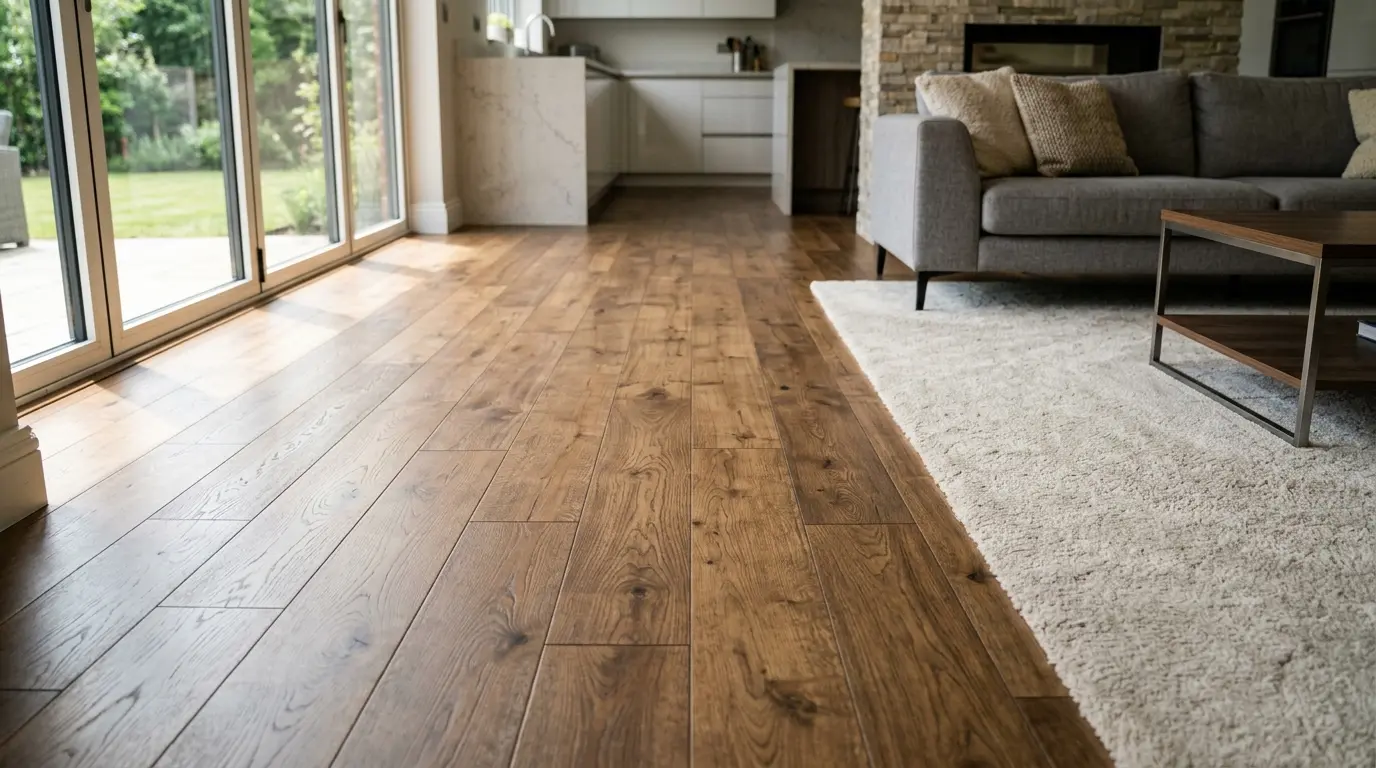

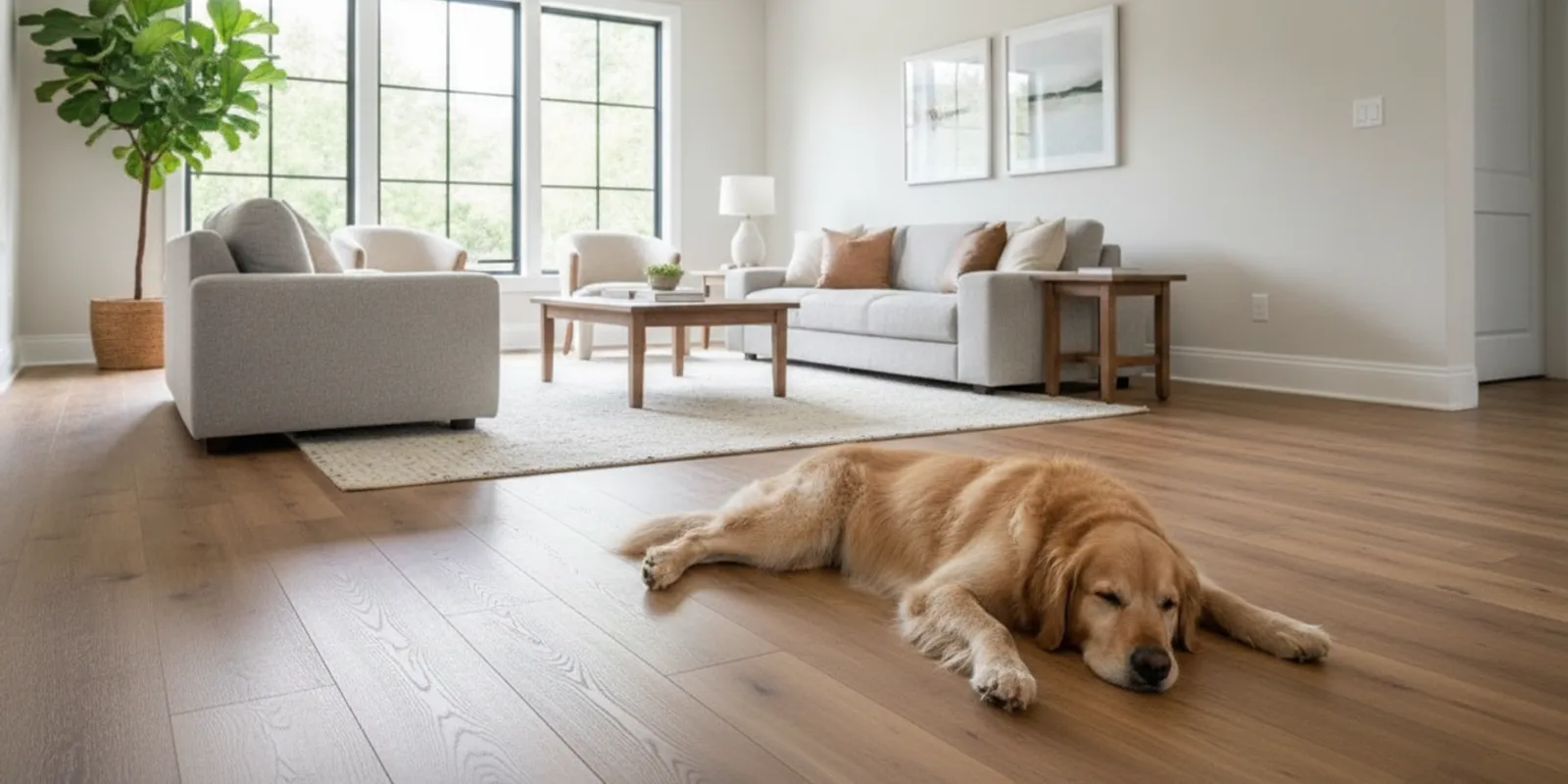
The best flooring options for pets depend on more than whether a product is labeled durable. Paw traffic, spills, claws, room conditions, and installation details all matter. Luxury vinyl plank (LVP), laminate, and hardwood each have tradeoffs; the right fit depends on your household and the specific product specifications.
Request a free flooring estimate
What should pet owners weigh before choosing a floor?
Start with the kinds of wear your floors actually see, not an idealized picture of pet ownership. A dog that comes in wet from the yard creates a different challenge from a small indoor cat. A puppy may have accidents during training; an older pet may need a surface that feels more secure underfoot. Food and water bowls, litter areas, doorways, favorite resting spots, and routes between rooms each create their own patterns.
Think about a typical day and a difficult day. Where does your pet wait while you get ready to go out? Where does it run after coming in? Which room has bowls, a litter box, or a pet bed? Where does water tend to splash? The answers can reveal that a floor needs to perform differently in different parts of the home. A single material throughout may still make sense, but it should be a deliberate choice rather than an assumption.
- How often do pets track in water, mud, or grit?
- Are accidents likely, and how quickly can someone clean them?
- Do claws catch, click, or mark the current floor?
- Does the animal slip when turning, stopping, or getting up?
- Are there direct-sun areas, entryways, or rooms with different flooring already?
- Will the floor need to coordinate with stairs, trim, cabinetry, or adjoining rooms?
- Can you keep the pet out of a room while the installation is underway?
- What appearance and maintenance are you willing to accept over time?
Separate the flooring surface from the whole installation system. The product, underlayment or adhesive, subfloor, transitions, and edge details affect the finished result. Ask for the specific product information and installation requirements rather than relying on a broad label such as pet-proof or waterproof. These labels do not explain every exposure, installation condition, or warranty exclusion.
It also helps to set priorities in order. For one household, quick cleanup after spills may come first. Another may place more value on the look and feel of real wood. A family with a senior pet may pay special attention to traction and unobstructed routes. Ranking the priorities helps you make a useful comparison instead of looking for one product that promises to solve every problem.
How does luxury vinyl plank work in a pet household?
LVP is a common option to consider when a household wants a hard surface that is straightforward to clean. Its surface can be wiped after routine spills, but product construction and warranty language vary. Do not assume every LVP product can tolerate standing water, repeated accidents, or moisture coming from below the floor. Follow the selected manufacturer's instructions for cleaning and moisture conditions.
Look beyond the word vinyl and compare the actual products being considered. Surface texture, finish, plank format, wear layer, locking or adhesive system, and care instructions may differ. Ask what the manufacturer's documentation says about spills and standing water, what cleaner is allowed, and whether the product is recommended for the room. A product name alone is not enough to answer those questions.
Surface texture and finish influence how paw marks, dust, and small scratches show. A sample viewed in a store may look different in a larger area and under your home's light. Ask to see the actual product and consider a sample in the room before deciding. A textured appearance may disguise some day-to-day marks, but it does not prevent damage. A very dark or very light surface may make dust, fur, or paw prints more visible, depending on the color and lighting.
Installation method also matters. Click-lock and glue-down systems have different substrate and project requirements. The floor must be suitable for the chosen product and method, and existing flooring removal, repairs, or leveling should be discussed in the written scope. Learn more about LVP installation and its planning considerations before comparing proposals.
For a pet household, consider the edges and perimeter as part of the plan. Spills that reach a seam, doorway, or wall edge may behave differently from a small spill on an open part of a plank. Ask how doorways, transitions, cabinets, and fixed features will be handled, and follow the product directions for cleaning liquid near edges. Avoid treating a surface claim as a promise that all water exposure is harmless.
LVP may be worth shortlisting if you want a hard surface and can follow the product's cleaning and use directions. It may be less attractive if the exact finish is not comfortable underfoot, if a particular product does not suit the room's conditions, or if the installation substrate needs work outside your project plan. The material is not a substitute for selecting the right product and preparing the room.
When might laminate be a practical choice?
Laminate can suit households seeking a wood-look surface and a floating installation system. It is not automatically the best choice for every pet or every room. Water resistance depends on the specific product and its installation details. Edges, joints, and perimeter conditions deserve attention, especially where spills may sit or recurring moisture occurs.
Ask what the manufacturer permits for cleaning, how quickly liquid should be removed, and whether the product is appropriate for the room. Do not treat a water-resistant claim as permission to leave accidents or bowls leaking on the floor. Check the manufacturer's written coverage and exclusions. If a pet has recurring accidents, or if a water bowl sometimes tips, say so when comparing products; the frequency and cleanup routine are relevant to the decision.
Laminate also needs the right substrate, underlayment, and expansion provisions. Doorways, floor-height changes, and transitions to other surfaces should be planned. ValorCraft's laminate flooring information describes the floating system and the importance of transitions and product-specific requirements.
Ask to see the sample in the actual room, at different times of day if practical. The room's light and neighboring finishes can change how a color reads. Check the surface from standing and seated height, because a pet's favorite resting areas may be viewed from close range. Look at more than one plank when possible so the pattern variation is easier to judge.
Laminate can be a reasonable option when its appearance and product instructions fit the household. It deserves extra scrutiny where liquid could be left unattended or where moisture conditions are uncertain. If the room includes a laundry area, exterior door, or other repeated wet exposure, ask directly whether the exact product and installation are appropriate. Do not rely on a general description of the product category to settle a room-specific question.
Can hardwood work with pets?
Hardwood may be a good fit when its appearance, repairability, and long-term care align with the homeowner's priorities. It can show scratches and dents, and water left on wood may damage the finish or boards. Wood species, finish, board construction, and household habits change how visible wear becomes. No wood floor should be treated as immune to claws, grit, or spills.
There is no single hardwood response to pets. A matte or varied finish may show everyday marks differently from a smooth, reflective finish, but the exact result depends on the product and room. Species and board characteristics also affect the visible pattern and how dents or scratches stand out. Ask to compare actual samples and discuss what signs of normal use you are comfortable seeing rather than assuming one finish is scratch-proof.
Trim pets' nails as appropriate, use mats at entrances, and clean grit promptly to reduce abrasive wear. Wipe spills rather than leaving them to dry. Follow the flooring and finish maker's care guidance; avoid cleaners or wet-mopping routines that the product does not allow. Even with careful maintenance, a pet household should expect a wood surface to acquire some signs of use over time.
Existing hardwood may not need replacement if the wear is primarily in the finish, but condition must be assessed. Board damage, prior sanding, remaining wear layer, and the extent of the affected area all matter. See hardwood sanding and refinishing for the type of evaluation involved. For a new floor, review hardwood installation options and confirm the suitable system for the room and substrate.
When the existing wood is structurally sound but visibly worn, compare an evaluation of the current floor with the cost and disruption of replacement rather than assuming a new material is required. Refinishing is not suitable for every floor or every condition. A professional assessment should identify whether the boards can be worked on and what repairs or finish choices may be needed. If damage is isolated, ask whether repair is feasible and how closely a repair may blend; do not assume a perfect match.
How do the main choices compare?
This table is a starting point for discussion, not a product ranking. Individual products vary, so ask for written care instructions and installation requirements for the exact option under consideration.
| Option | Potential advantages | Questions and cautions | Good planning focus |
|---|---|---|---|
| Luxury vinyl plank | Hard surface; routine spills are generally easy to wipe from the surface when handled promptly. | Product moisture limits, scratching, texture, and installation method vary. | Confirm product instructions, substrate readiness, method, and transitions. |
| Laminate | Wood-look styles and floating click-lock construction are available. | Water tolerance and edge or joint behavior depend on the chosen product. | Ask about spill response, underlayment, expansion, and room suitability. |
| Hardwood | Natural wood appearance; some existing floors may be candidates for refinishing. | Claws, grit, and moisture can mark or damage the floor and finish. | Discuss species, finish, existing-floor condition, and care expectations. |
When comparing options, separate the desired look from the way a room is used. A household may prefer the appearance of wood but have frequent water exposure at a back entry. Another may value a hard surface for cleanup but want a warmer look in bedrooms. Consider the whole floor plan, not just a product in isolation: transitions and changes in height can affect how rooms connect and how the installation is completed.
If you are weighing LVP against laminate, this comparison of vinyl plank and laminate can help frame the tradeoffs. The appropriate choice still depends on the specific products, installation conditions, and daily routines in your home.
How should you evaluate a floor sample for pets?
A sample is useful, but it cannot show every issue that appears across a completed floor. Use it to compare color, surface feel, texture, and the way the finish interacts with light. It is not a durability test, warranty review, or substitute for checking product documents. A few deliberate observations can make a product discussion more concrete.
- View it where it will be installed. Put the sample near the entry, bowl area, or main walking route. Check it in daytime and evening light, and compare it against cabinets, trim, and furniture.
- Look at the surface from more than one angle. Notice whether texture or gloss makes dust, hair, paw marks, and small surface marks more visible.
- Consider the pet's movement. Observe whether the finish feels secure to your pet if a test area or existing sample surface is available. Do not infer guaranteed traction from a hand test.
- Read the care and use instructions. Find the manufacturer's approved cleaners and any directions about spills, moisture, rugs, or furniture protectors.
- Ask how the product is installed. Confirm whether it is floating or bonded, what substrate conditions are required, and how perimeter and transition details are addressed.
- Keep the product identification. Save the exact name, color, documentation, and proposal so you can compare like with like and follow the correct maintenance guidance.
A sample can also help family members align on expectations. Ask each person to describe the marks or color variation they would find acceptable. This is more useful than debating whether a floor is perfectly pet-proof. The goal is to choose a product whose expected appearance and care are workable for the household.
How do pets change the room-by-room decision?
Different parts of the home can face different types of wear. The same flooring may work throughout, but there is no requirement that every room be treated as if its exposure is identical. Consider where pets enter, eat, rest, play, and sleep, along with the floor materials in adjoining rooms. If you plan to use more than one surface, have transitions and room boundaries included in the conversation.
Entries and routes from outdoors
Entries can collect grit, water, and debris carried in on paws. A washable mat and a routine for wiping paws can reduce the amount that reaches the floor, but the mat should be stable and compatible with the selected surface. Ask about product guidance for rug pads and rubber or latex backing; not every backing is suitable for every finish. If the entry repeatedly gets wet, prioritize the exact product's room and moisture instructions rather than choosing by appearance alone.
Think through the path from the door to the place where wet paws are cleaned. A runner may help, but it can shift, curl, or catch a pet's feet if it is not secured appropriately. Keep walkways clear and check that mats do not block doors. Flooring selection and household habits work together: the most suitable surface still benefits from prompt cleanup and a practical entry routine.
Food, water, and litter areas
Bowls can create repeated small spills. Place them on a washable tray or mat if appropriate for the floor and keep the area dry. Check for leaks or splashes routinely instead of waiting for a visible problem. If the product has limits on standing water or certain cleaning methods, make sure the bowl-area routine is compatible with those directions.
For litter areas, plan for scattered grit and frequent sweeping or vacuuming. A mat may catch some material, but it needs to be cleaned and kept in place. The details matter: grit left under a mat can still abrade the surface, and a wet or unsuitable backing can create its own concern. Check the flooring maker's rug and cleaning guidance before settling on a setup.
Living rooms and favorite resting places
In living areas, pets may turn quickly, jump down, or repeatedly move between a bed and a door. Consider traction, clear routes, furniture legs, and the location of rugs. Felt protection under furniture can reduce scuffing when chairs or tables move, while a stable pet bed can help define a resting place. Keep cords, toys, and loose mats out of high-speed paths.
If the animal spends much of the day in one sunny area, ask whether the specific product has relevant care or exposure guidance. Do not assume every material responds to sunlight in the same way. Compare the product documents and consider how curtains, rugs, and furniture affect the floor's exposure.
Bedrooms, stairs, and transitions
Bedrooms may experience less outdoor grit but still need a cleanable routine and suitable surface care. Stairs deserve separate thought because a pet's footing, stair geometry, edges, and transitions create concerns beyond the open floor area. If stairs are part of the project, identify them explicitly. Do not assume a room-floor quote includes stair treads, risers, nosings, or finishing details.
At thresholds, the change in surface and height should be planned. A pet may cross the transition many times a day, so loose or awkward edges are undesirable. Ask what transition detail is proposed and how it relates to the adjoining floor. For broader project planning, the guide to floor transition strips explains why these details are part of a flooring plan.
What helps reduce scratches, slips, and mess?
No flooring choice removes the need for basic care. A few habits can reduce avoidable wear and make cleanup more manageable. Set up routines that are realistic for the people who will actually maintain the floor, and follow the selected product's care instructions.
- Place washable mats near exterior doors and water bowls, and keep mats from becoming a trip hazard.
- Use felt protection under furniture and avoid dragging heavy items across the floor.
- Keep nails maintained as appropriate and wipe paws when they are wet or gritty.
- Clean accidents promptly using a method approved for the flooring product.
- Use a vacuum or soft broom suited to the surface to remove abrasive grit.
- Choose runners or rugs in high-traffic areas only when they are compatible with the floor and have a suitable backing.
- Move a pet bed or bowl mat periodically to check for trapped grit or moisture underneath.
- Keep a product-approved cleaner and soft cloth accessible so spills can be handled without improvising.
Traction deserves attention, especially for older animals or pets with mobility concerns. Gloss, texture, surface dust, and paw condition can affect how secure a pet feels, but no material guarantees slip resistance in every circumstance. If slipping is a concern, ask to assess the actual finish and consider washable, stable runners in the areas where the pet turns or rests. Discuss persistent mobility concerns with an appropriate animal-care professional; flooring is only one part of the environment.
Cleaning should follow the product maker's instructions, not a generic routine from another floor type. Some products may not allow a cleaner, scrubber, steam device, or amount of water that is appropriate elsewhere. Read the instructions before a spill happens, and test a method only as directed. Avoid mixing cleaners or using a strong product simply because a stain is difficult. A compatible, prompt approach is safer than a harsh treatment that could affect the finish or warranty.
For accidents, remove solids carefully, blot or wipe liquid as directed, and clean the affected area with an approved method. Check seams, edges, and nearby transitions if liquid could have reached them. If the floor is damaged or a spill has remained for a long time, consult the product guidance or a qualified flooring professional about next steps. Do not conceal a recurring moisture issue beneath a mat or rug.
What should an installer assess before work begins?
A useful consultation starts with the rooms, existing floor, and household priorities. Share where pets spend time, where water or outdoor grit enters, and whether you expect the home to remain occupied during work. Bring product preferences, photos, and any plans for adjoining rooms or stairs. Mention known accidents, repeated spills, or mobility concerns so the proposed surface and room plan can address real use.
The assessment should address the substrate and the proposed flooring system. Subfloor flatness, moisture conditions, existing adhesives, and floor-height changes can affect what is appropriate. Limits and test methods are product- and project-specific. Ask what preparation is needed and whether it is included, separately priced, or conditional on what is found after removal. A surface that looks smooth before demolition may reveal conditions that were not visible.
For preparation details, review subfloor preparation. The written estimate should define the actual scope. Demolition, haul-off, leveling, moisture mitigation, furniture moves, and finish work are not automatically bundled unless the proposal says so.
Planning questions worth settling include:
- Which rooms and transitions are included in the quote?
- What product, installation method, and underlayment or adhesive are proposed?
- Is removal and disposal of existing flooring included?
- Are leveling, patching, moisture work, or damaged-subfloor repairs included, excluded, or subject to assessment?
- Who moves furniture or appliances, and what must be cleared before the crew arrives?
- How will trim, doorways, stairs, and edges be finished?
- What cleaning and access restrictions apply during installation and any product-specific curing period?
- What should household members do to keep pets away from the work area?
- How will the household access essential rooms while work is in progress?
How should you prepare a pet household for installation?
Flooring work changes access to rooms and introduces tools, materials, open doorways, and unfamiliar activity. Plan for the pet as part of the project rather than improvising on installation day. Ask the installer which spaces will be affected, what access restrictions apply, and how the work sequence is expected to proceed. Keep pets away from active work zones and follow the crew's instructions.
Before work begins, decide where the animal will stay during the day and whether that location is quiet and secure. If the pet is sensitive to noise or strangers, discuss whether it should be elsewhere during the work. Arrange a safe route to the yard or litter area that does not cross the work zone. Do not assume a closed door will remain closed if a crew needs to move materials through it.
Confirm which rooms need to be empty and who is responsible for moving furniture, bowls, beds, crates, and toys. Protecting the animal's routine can be as important as clearing the floor. Pack familiar items together so they can be placed in a safe room. Remove loose toys from hallways and make a plan for feeding and bathroom breaks while access is limited.
Ask for the manufacturer's and installer's direction about when the pet can return to a room. This may depend on the material, installation method, adhesive or finish, ventilation, and project conditions. Do not invent a universal waiting period. If the proposal includes a cure or restricted-access period, get the instructions in writing and follow them. Keep the pet away until the stated conditions are met.
After installation, walk the rooms before giving the pet full access. Check that transitions and trim are complete, rugs are placed as intended, doors open correctly, and no tools or debris remain. Follow the care and cleaning instructions for any initial residue or maintenance. If you notice an issue, document its location and raise it promptly rather than trying an unapproved repair.
How can homeowners compare estimates fairly?
Compare proposals by scope, not only by the product name or total. One estimate may include removal and trim while another treats those as separate work. Ask each contractor to identify the product, installation system, room boundaries, preparation assumptions, and what happens if the substrate differs from what was visible during the initial visit.
Use a short checklist:
- Confirm the same rooms and approximate project boundaries are being compared.
- Check the named product and its care and moisture instructions.
- Compare removal, disposal, substrate preparation, and trim line by line.
- Identify exclusions, allowances, and conditions that could change the scope.
- Ask how pet access, furniture, and household movement will be handled during the work.
- Confirm whether stairs, closets, thresholds, and unusual edges are included.
- Keep the final written scope and product documentation for reference.
A written estimate should help you understand what is planned, what assumptions it uses, and what is outside the scope. Ask how additional work would be discussed if removal reveals a condition that could not be assessed beforehand. It is reasonable to request clarification before approving a change. A comparison is meaningful only when you know whether both proposals cover the same rooms, preparation, and finish details.
Do not compare only the sample price or broad category. Two LVP selections may differ in product requirements and installation method; two laminate selections may have different moisture guidance; two hardwood plans may involve different existing-floor conditions. Compare exact product identification and the work required to install it. If the proposal is not specific enough to answer your questions, request clarification in writing.
A free estimate is a consultation and quote, not a fixed price for unknown conditions or a promise of a particular schedule. Provide accurate room details and ask questions before approving work. To discuss a home in the Piedmont Triad, send project details to ValorCraft Flooring.
What are common pet-flooring selection mistakes?
One common mistake is treating a category label as a guarantee. Calling a product waterproof, scratch-resistant, or pet-friendly does not tell you whether it suits a specific room, installation method, or kind of exposure. Read the actual documentation and ask about the limits that matter in your home. A claim should be understood in the product's defined context.
Another is choosing by a small sample without considering the entire room. Color, pattern repetition, lighting, adjoining surfaces, and the appearance of everyday fur or dust become more noticeable across a larger area. Bring the sample home if possible, view it in the intended room, and compare it with the trim and furniture you plan to keep.
A third is assuming that the floor surface alone determines performance. A suitable product can still be a poor fit if the substrate is not prepared for its installation system or if the edges and transitions are not planned. Ask about underlayment or adhesive, removal, preparation, and the way the floor meets other surfaces. Confirm the scope instead of assuming details are included.
Some households also underestimate maintenance. A hard surface still needs prompt spill cleanup, grit removal, and product-appropriate care. A rug can help in a high-traffic area but may trap dirt or create a slipping hazard if it moves. Be realistic about the routine you can maintain, and select a product whose care instructions are practical for your household.
Finally, do not choose based solely on one pet's behavior at one moment. Consider life changes such as a new puppy, aging animal, different feeding setup, or increased time outdoors. No one can forecast every change, but a durable decision acknowledges current patterns and asks how much flexibility the household wants. If you are uncertain, prioritize the conditions that happen most often and verify product suitability for the less common but higher-risk exposures.
Which pet-friendly floor is the right fit?
For many households, the choice comes down to priorities. LVP may be worth comparing when easy surface cleanup is central; laminate may suit a household that prefers its look and follows product-specific spill guidance; hardwood may fit when its natural appearance and care needs align with the family's habits. None is a universal solution. Select a specific product, understand its limits, and make sure the installation plan fits the room.
A practical way to decide is to write down your top three needs, then evaluate each product against them. For example, a household might prioritize routine spill cleanup, a wood-look appearance, and a manageable care routine. Another might prioritize preserving an existing wood floor, accepting visible wear, and limiting unnecessary replacement. These priorities lead to different conversations, and neither list determines the answer without checking the specific products and floor conditions.
For an existing home, also decide whether the project is replacement, refinishing, or a mix by room. The present floor's condition and the floor height at doorways can influence the plan. For a new selection, consider how the surface will connect with rooms that are not part of the project. A clear scope makes it easier to understand what the estimate covers and how the final spaces will meet.
Request a free estimate for your flooring project
Frequently asked questions
Is any flooring completely scratch-proof for pets?
No. Surface marks depend on the product, finish, debris, pet activity, and care. Ask what the manufacturer's documents say about wear and maintenance, and consider whether the appearance of ordinary use is acceptable to you. Mats, nail care, and prompt grit removal can reduce some avoidable wear, but they cannot guarantee a mark-free floor.
Is LVP always waterproof enough for pet accidents?
No. Products differ, and the installation system and room conditions matter. Check the exact product's written moisture instructions and warranty language, clean accidents promptly, and ask whether the proposed installation is suitable for the room. Do not use a broad category label as a substitute for product-specific guidance.
Can I keep hardwood if I have a dog?
Possibly. Consider the condition and construction of the existing floor, the finish, how much visible wear you accept, and your care routine. A qualified assessment can determine whether refinishing or repair is appropriate. Hardwood is not immune to scratches, dents, or moisture, so set expectations before choosing it.
Should I choose one floor for the whole home?
That depends on your design preferences, room exposure, and transition plan. A consistent surface can create visual continuity, while different rooms may have different moisture, traffic, or maintenance needs. Discuss room boundaries and transitions before deciding, and confirm how each proposed product suits the specific areas.
What should I ask for before signing a flooring estimate?
Confirm the product, rooms, installation method, preparation, removal and disposal, transitions, trim, exclusions, and any conditions that could change the scope. Ask how to prepare the home and keep pets away from active work. Keep the written estimate and product care instructions so you can refer to the agreed plan later.
Share your rooms, pets, existing floor, and concerns with the estimator so the written proposal can address the details that matter in your home.