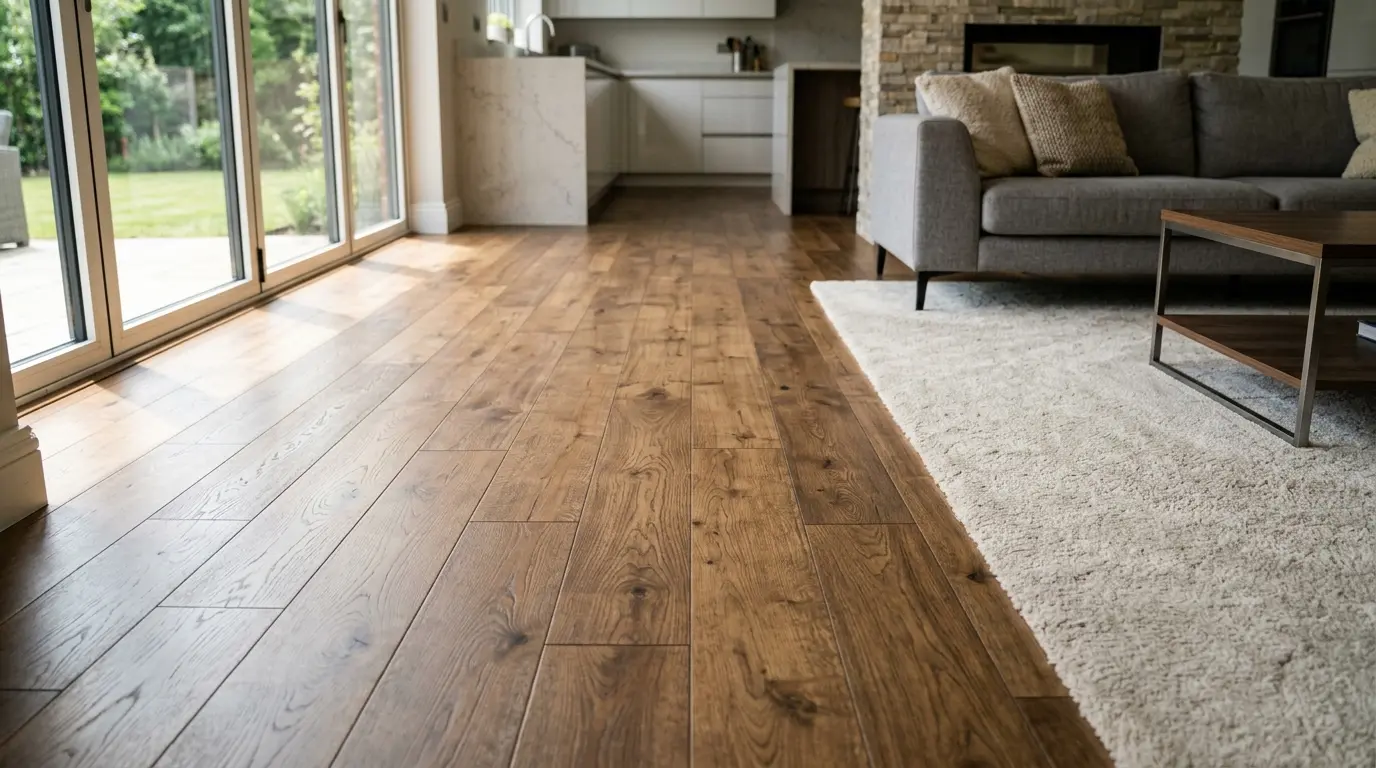
Click-lock vinyl plank vs glue-down vinyl flooring is a method choice, not a brand choice. Both can look like wood. Both can be luxury vinyl plank. The difference is how the floor is held in place, and that changes the subfloor work, the sound underfoot, the repair, and the line items on a written estimate.
A click-lock floor floats, because the planks lock to each other and rest on an approved underlayment. A glue-down floor is bonded to the substrate with the adhesive the product calls for. ValorCraft Flooring installs both across Greensboro, High Point, Winston-Salem, Lexington, Kernersville, and Thomasville. The product spec and the floor underneath decide which one belongs in the room.
Request a free in-home consultation
How Click-Lock Vinyl Plank and Glue-Down Vinyl Flooring Differ.
Start with the system, not the picture on the box. Two planks can share a color and a wear layer and still be different products. One is milled to lock, and the other is made to be spread with adhesive. You cannot treat them as interchangeable on site.
What a click-lock floor actually does.
Click-lock vinyl plank, often called floating LVP, snaps tongue to groove so the finished field becomes one mat. It is not fastened to the slab or the plywood. That is why the manufacturer requires an expansion gap at walls, cabinets, columns, and other fixed objects. The mat needs room to move with temperature.
Most floating products also need underlayment. Some planks have a pad attached, while others need a separate foam or cork sheet that the maker approves. Doubling a pad under a pre-attached product is a common way to make joints rock. The written spec should name which pad, if any, is allowed.
What a glue-down floor actually does.
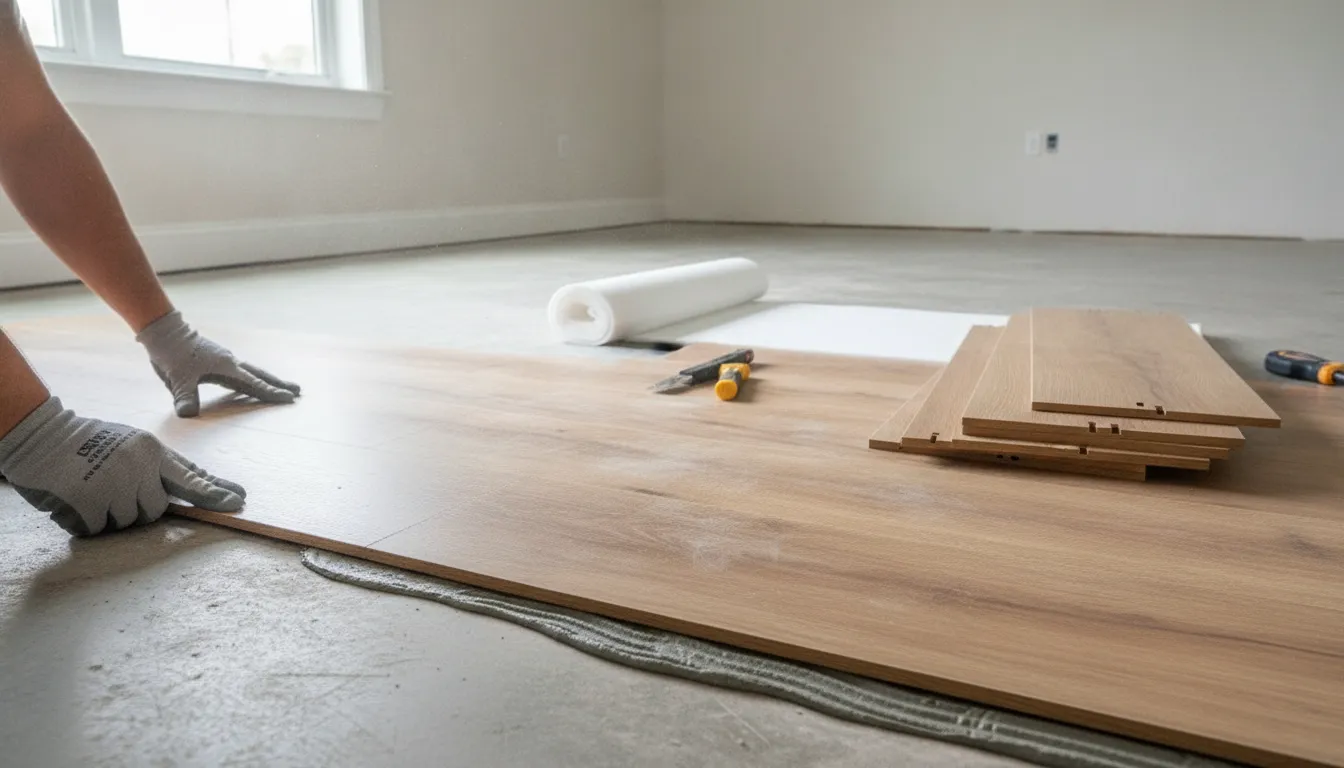
Glue-down vinyl flooring is spread and set into adhesive. Full-spread means the adhesive covers the substrate, not a few dots. The trowel notch, open time, and working time come from the adhesive and plank instructions. Guessing at the notch leaves hollow spots, or a bond that never grabs.
Because the plank is stuck down, the floor does not float as a mat. Heavy point loads and rolling traffic have less chance to flex a joint. The tradeoff is cure time and a harder future repair. Light foot traffic is often possible after about 24 hours, and heavier loading after about 48 to 72 hours, but only if the adhesive, temperature, and humidity match the spec.
Click-Lock Vinyl Plank vs Glue-Down Vinyl Flooring by Room.
There is no universal winner, because a quiet bedroom and a slab kitchen can call for different systems even in the same house. Use the room, the substrate, and the product allowance together.
| Question | Click-lock floating vinyl plank | Full-spread glue-down vinyl |
|---|---|---|
| How it is held. | Planks lock to each other and float. | Planks bond to the substrate. |
| Typical home fit. | Bedrooms, living rooms, and simple wood-subfloor rooms when the product allows. | On-grade slabs, kitchens, entries, and heavy or rolling traffic when the spec calls for a fixed floor. |
| What must be right first. | Flatness, approved underlayment, and expansion gaps. | Moisture test, flatness, correct adhesive, and trowel notch. |
| Feel underfoot. | Often a little give. Sound depends on the pad. | Firmer, with less joint flex. |
| After install. | Usually walkable once the field is locked and trimmed. | Wait on the adhesive cure before heavy use. |
| Later repair. | A damaged plank can often be unlocked if the layout allows. | A hard-set plank may need careful lifting and a new bond. |
Bedrooms, living rooms, and simple layouts.
Click-lock is often the practical choice in bedrooms and living rooms on a wood subfloor that is already flat, and the install is cleaner because there is no open adhesive. Transitions at doorways still matter, because a floating field that runs under a door without the right T-molding can pinch and peak.
Glue-down can still be the right bedroom floor if the plank is a glue-down product. It also fits when the room shares a slab and you want one fixed system. Do not pick the method from habit. Read the carton.
Kitchens, entries, and slabs.
On-grade concrete is where glue-down earns its place, provided the moisture test passes and the product allows a bonded install. A floating floor can also go on a slab when the maker allows it and the underlayment is the approved one. The slab still has to be flat, and a pad does not fix a ridge.
Entries and kitchens see water, grit, and appliance loads. Water resistance is a product claim, not a method claim, so the carton still decides the room. A click-lock plank with a weak joint can still wick at the seam if the wear layer and locking profile were not made for that room. Ask for the wet-area allowance in writing before you choose either system for a laundry or a bath.
Stairs are a separate scope.
A floating field does not run down a stair, because stair work uses nosings and often a bonded tread cap sized to the step. Glue-down stair installation is quoted on its own. Stringer repair, returns, and haul-off are not assumed. The local inspector has the last word on stair details.
What the Subfloor Has to Do Before Either Method.
Both systems fail on a bad substrate, and the failure just looks different. A floating joint rocks and separates, while a glued floor telegraphs ridges and loses bond where the adhesive never wet out.
Flatness is a product rule.
ValorCraft checks flatness before the first plank. On LVP work, that check is often 3/16 inch over 10 feet, but only when that is the figure the selected product uses. Another brand can publish a tighter number. High spots get ground, low spots get floor patch or self-leveler, and fasteners that would print through the wear layer come out first.
Subfloor preparation is a line item, not a free extra. If a quote skips leveling, ask what flatness standard it used and what happens if the floor misses it.
Moisture decides whether glue is even allowed.
Adhesive on a wet slab is a failed floor waiting to happen, so glue-down work starts with a moisture test on concrete before the pail is opened. If the reading is outside the adhesive's limit, the next step is mitigation or a different system, not a heavier trowel and a hope that it holds.
Floating LVP can be more forgiving of a slab that is not a candidate for glue, but it is not a license to ignore moisture. Some products still set a limit, and a wet slab can damage underlayment or swell a wood subfloor at the edges. The test result belongs in the job notes so the next trade can see it.
Old floors and old adhesive.
Overlay is possible only when the product allows it and the old floor is stable, flat, and within the height the doorways can spare. Tile often needs grout lines filled so the joints do not telegraph. Hardwood overlay depends on movement and the manufacturer's written allowance.
Pulling up an old hard-set floor is its own task, and scraping is normal. Grinding or disturbing adhesive that might contain asbestos is not. That material needs a qualified assessment and clearance before anyone disturbs it. Flooring removal and disposal should be named on the estimate when it is part of the job. It is not bundled by default.
Sound, Repairs, and the Claims Worth Ignoring.
Marketing copy treats one method as quiet and the other as loud, but installers disagree in public because they are often describing different pads and different adhesives. Treat feel and repair as conditional on the product in front of you.
Noise depends on the pad and the bond.
A floating floor can sound hollow if the underlayment is thin or if the plank is bridging a low spot. A better pad, when the product allows one, usually softens footfall across the room. A glue-down floor usually feels firmer because there is no air gap, but that firmness is not the same thing as silence. A hard-set floor on a bare slab can still carry impact into the room below.
If quiet is the goal, say so at the visit, because the answer may be an approved acoustic pad, a different adhesive, or a different product. It is not a promise that one method is always the quieter floor.
Repairs are rarely as easy as the brochure.
Click-lock is often easier to open when the damaged plank is near an edge, or when the layout was planned for a future repair. A plank in the middle of a locked field can still force a larger opening. Glue-down repairs mean lifting one plank without tearing the neighbors, then bonding a replacement that matches the original dye lot. If that lot is gone, the patch will show against the field.
Neither method is maintenance-free, because grit, pet nails, and dragged appliances cut the wear layer on both. Keep a few extra planks from the same lot in a closet. That is the cheapest repair you will ever make, and it should be part of the original order rather than an afterthought.
Do not glue a click-lock plank unless the maker says so.
Some people try to glue a floating plank to stop a squeak, but that can void the warranty and trap the floor so it cannot move. A few products do allow a glue-assist at the perimeter or in a sunroom, and that instruction has to be in the current product sheet. If it is not written there, do not invent the step on site.
What a Written Estimate Should Name.
The useful comparison is the estimate, not a price you found online. ValorCraft does not publish a rate for either method, and the written estimate is the scope. If a line is missing, that work is not included.
Ask the estimate to name each of these, even when the answer is "not in this job":
- The exact plank and whether it is a click-lock or a glue-down product.
- The underlayment or the adhesive, including who supplies it.
- Moisture testing, and moisture mitigation if the slab needs it.
- Leveling, patching, or grinding, with the flatness figure being used.
- Removal and haul-off of the old floor, if any.
- Transitions, reducers, stair nosings, and quarter round or base shoe.
- Furniture or appliance moves, and who puts them back.
- Cure or return-to-use timing, tied to the adhesive or the product, not a slogan.
Removal, haul-off, leveling, moisture mitigation, moves, and stair extras are never automatic. A low quote that skips them is not a better price, because it is a different job. Luxury vinyl plank installation at ValorCraft uses in-house crews, and the method follows the product and the substrate. Glue-down flooring is the page to read when the spec calls for a full-spread bond.
For the variables that change an LVP price, read the separate guide on luxury vinyl plank installation cost. This article stays on the method. It does not replace that page, and it does not quote a number.
A free in-home consultation is a look at the rooms and a written quote, not free installation. It fits best when the project is roughly 250 square feet or more and you expect to start within about three months. Smaller or later jobs are still welcome to ask, and that note is a fit guide rather than a refusal.
Frequently Asked Questions.
Is click-lock vinyl plank the same product as glue-down vinyl?
No. They can share a look, but the plank is built for one system. Click-lock has a locking edge and usually floats, while glue-down is made to sit in adhesive. Use the product the manufacturer rated for the method you want.
Can you install click-lock vinyl plank on concrete?
Often yes, if that product allows a slab and you use the underlayment it names. The slab still has to be flat, and the moisture reading still has to stay within the product limit. Concrete alone does not force you into a glue-down install.
Which is better for a kitchen in the Piedmont Triad?
Use the plank's wet-area rating and the substrate, not the city the house sits in. A glue-down floor is a strong fit on an on-grade slab that passes a moisture test before the adhesive is opened. A click-lock floor can also work when the product allows the room and the locking joints are made for spills. Confirm both allowances in the written spec.
Does glue-down vinyl need a cure time before furniture goes back?
Yes. Light traffic is often fine after about 24 hours, and heavier loads often wait about 48 to 72 hours. Those windows move with the adhesive, the room temperature, and the humidity. The estimate should cite the product you are actually getting, not a generic cure slogan.
Will the estimate include tear-out and transitions?
Only if the estimate says so. Demo, haul-off, leveling, transitions, and stair nosings are separate line items. Read the written estimate before you compare it with another company's quote.
Choose the Method Before You Choose a Color.
Click-lock vinyl plank vs glue-down vinyl flooring comes down to the product sheet and the floor you already have in the house. Floating click-lock suits many wood-subfloor rooms when flatness and expansion gaps are respected. Full-spread glue-down suits slabs and heavier use when the moisture test and the adhesive rules are met. ValorCraft will name the method, the prep, and the exclusions in the written estimate.