Subfloor Preparation
Leveling, patching, moisture testing, and substrate prep — the difference between a floor that looks great today and one that lasts decades.
- Veteran-Owned & Operated
- Licensed & Insured
- In-House Crews — No Subcontractors
Built for Buildings That
Can't Slow Down.
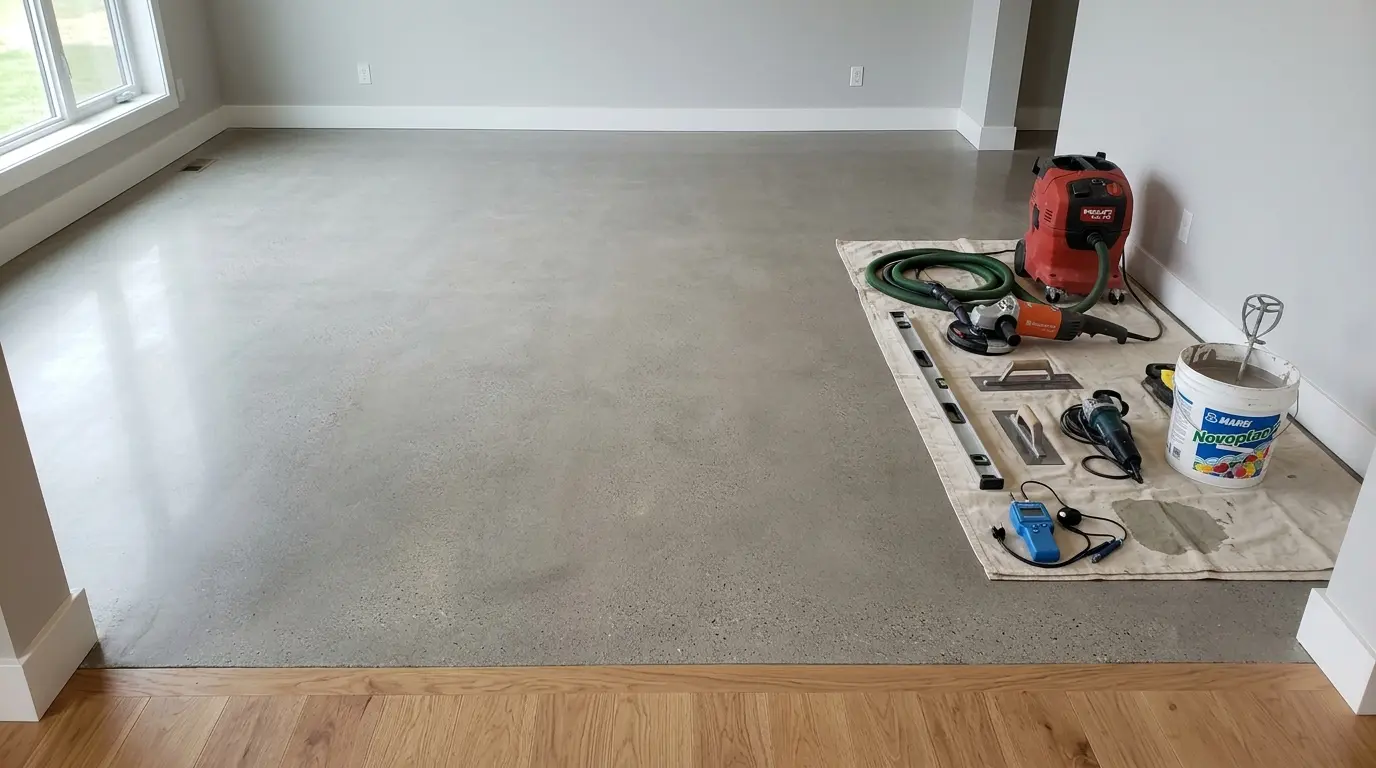
No amount of skill in laying a floor makes up for a bad substrate underneath it. Hollow spots telegraph through LVP and cause joints to flex and separate. Moisture in a slab destroys adhesive bonds and causes hardwood to cup. High spots in a plywood subfloor create pivot points that break click joints over time. ValorCraft treats subfloor preparation as a standalone discipline — not a checkbox before the real work starts. We flatten, patch, test for moisture, and document what we found so the floor installed on top of our prep is set up to perform the way it's supposed to.
- Flatness verified to 3/16" over 10 ft — the threshold most manufacturers require
- Calcium chloride and in-situ RH probe testing for slab moisture vapor emissions
- Self-leveling underlayment for larger low-area corrections
- Substrate condition documented before the install crew mobilizes
Full Commercial Scope —
Demo To Punch List.
One contract, one crew. Substrate prep, install, transitions, and base — everything that touches the floor stays under our scope.
Subfloor Flatness Check
Straight-edge and level measurements across the full floor area — high and low spots identified, mapped, and documented to the tolerance required by the new flooring product.
Grinding & Planing High Spots
Concrete high spots ground with a floor grinder; wood subfloor crowns belt-sanded or planed flush — both brought to within the tolerance the new floor requires before any material is placed.
Self-Leveling Underlayment
Poured self-leveling compound over prepared low areas on concrete or wood subfloor — mixed to the correct consistency, primed where required, and feathered to a flat surface without edge humps.
Floor Patch & Skim Coat
Portland cement patch or fast-setting floor filler applied to localized voids, cracks, trowel marks, and subfloor repair areas — feathered flat and allowed to cure before flooring is installed.
Moisture Testing — Concrete
Calcium chloride tests or in-situ relative humidity probe tests per ASTM F1869 or F2170 — readings documented, adhesive selection made based on results, and moisture mitigation recommended when readings exceed product limits.
Moisture Testing — Wood Subfloor
Pin or pinless moisture meter readings taken at multiple locations across the wood subfloor — compared to the incoming hardwood or engineered plank moisture content and documented before install.
Squeak Repair & Subfloor Fastening
Loose plywood panels screwed through to the joist, squeaky areas identified by walking the floor and secured with construction screws and adhesive — so the finished floor doesn't inherit movement from below.
The Commercial Standard
PMs Keep Calling Back.
Veteran-owned discipline applied to commercial flooring — clean schedules, accurate scopes, and crews that close out the punch list the first time.
Manufacturer Tolerance, Not Just 'Pretty Good'
We flatten to the tolerance the product spec requires — 3/16" over 10 feet for most LVP, hardwood, and laminate. A floor that feels flat to the foot is not the same as a floor that meets that spec.
Moisture Caught Before It's a Problem
Adhesive failures, cupped hardwood, and buckled LVP are almost always moisture problems that were never tested for. We test, document, and mitigate — before the floor goes down, not after.
Documented Substrate Report
After prep, we document what was found and what was done — high spots ground, patches applied, moisture readings recorded. The install crew starts with a known substrate, not an unknown one.
No Shortcut on Self-Leveler
Self-leveling compound poured incorrectly creates humps at the perimeter and voids in the field. We prime the substrate, mix to spec, and feather the pour — no ridges left for the floor to telegraph.
In-House Crews
Prep and install done by the same team — so the person who laid the self-leveler knows where the edges are and how it cured before the floor planks go down.
Veteran-Owned Transparency
If we open the subfloor and find something that changes the scope — a soft spot, a moisture reading out of range, delaminated OSB — you hear about it before we proceed.
Five Steps. No Surprises.
Schedules That Hold.
The same process whether it's one suite or one hundred — clear scope, clean prep, phased installs, and a closed punch list.
- 01
Substrate Inspection
We walk the full floor area with a straight-edge and moisture meter — mapping high spots, low areas, soft panels, and any visible cracking or damage before any prep begins.
- 02
Moisture Testing
Concrete substrates tested per ASTM F1869 or F2170 protocol; wood subfloor moisture measured and compared to incoming flooring material — results documented and adhesive selection confirmed.
- 03
Grinding & Fastening
High spots ground or planed; loose panels screwed to joists; protruding fasteners set flush — mechanical corrections done before any pourable or trowelable product is applied.
- 04
Patch & Self-Leveler
Floor patch applied to localized voids and cracks; self-leveling underlayment poured into low areas over primed substrate — feathered, allowed to cure, and re-checked for flatness before flooring mobilizes.
- 05
Final Flatness Check & Handoff
Straight-edge check across the prepped area; any residual high spots addressed; substrate condition documented and released to the flooring install crew or the GC.
Answers
Before You Ask.
How flat does a subfloor need to be for LVP or laminate?
Most LVP and laminate manufacturers specify no more than 3/16" variation over 10 feet (or 1/8" over 6 feet). We measure to this tolerance and prep to meet it — not to a visual inspection. A subfloor that looks flat to the eye often has variations that cause click-joint failure over time.
What is self-leveling underlayment and when do you use it?
Self-leveling is a pourable cementitious compound that flows into low areas on a concrete or wood subfloor and cures flat. We use it when the low-area correction is larger than what floor patch can address cleanly — typically depressions more than 1/4" to 3/8" over a wide area.
What moisture level is acceptable for a concrete slab?
The acceptable level depends on the flooring product and adhesive. Calcium chloride tests measure vapor emission in lbs/1000 sq ft/24 hrs — most adhesives specify a limit of 3 to 5 lbs. In-situ RH probes measure internal slab humidity — most products specify a limit of 75% to 85% RH. We document the actual readings and compare them to the product spec before any adhesive is opened.
Can you prep a subfloor with existing adhesive on it?
Yes. Old adhesive residue is ground, scarified, or skim-coated depending on the type and the new adhesive requirement. Cutback (black) mastic — which may contain asbestos — is typically encapsulated rather than mechanically removed.
Do you fix squeaks as part of subfloor prep?
Yes. We walk the subfloor before prep begins and secure loose panels and squeaky areas with construction screws and adhesive. If the squeak is caused by a structural joist issue rather than the subfloor panel, we identify it and discuss options — we don't cover it up with flooring.
Can subfloor prep be done as a standalone service?
Yes. If you have another flooring contractor doing the install and they need the substrate prepped and documented, or if you're planning a phased renovation, we'll prep the subfloor as a standalone scope and deliver a condition report.
Serving the
Piedmont Triad, NC.
ValorCraft Flooring proudly installs residential and commercial flooring across the Piedmont Triad and surrounding North Carolina communities.
Schedule In Your Area- 01High Point
- 02Greensboro
- 03Winston-Salem
- 04Lexington
- 05Kernersville
- 06Thomasville
- & surrounding Triad areas
Ready to Upgrade Your Floors?
From first estimate to final walkthrough, ValorCraft Flooring delivers professional flooring built to last.
(336) 596-7835 · valorcraftflooring@gmail.com